The signs of recovery are clearly here. The new clients we are currently working with are innovative, driven and hunting out the opportunities that exist in the changing landscape of their local, and global, economy. We've had a lean couple of years and seen private sector work drop off while public sector continued and then the recent reversal as private sector picks up and public sector halted slightly more immediately than expected!
However, with our broad spread of sectors, and balanced split between public and private sector work, we have come through these tough times stronger and in a position to still offer the breadth and depth of experience that is essential to help drive the visions of these new businesses forward. Whether it's helping in-house teams set up systems and templates using Microsoft Office to communicate consistently and on brand, helping businesses evolve through accessible change management programmes or naming and creating new identities and branding for start-ups, our skill sets are again being challenged and enjoyed by our clients.
With the naming exercises we've undertaken recently, the unsuccessful search for related URLs demonstrates why so many companies are opting for made up or mis-spelt names. But the name is an integral part of the brand so a little more lateral thinking relating to meaning and how the name might be developed as an identity helps create a stronger more effective brand.
This month, we looked at two new business wins that are capitalising on changes and requirements within their environments. Both early stage but already the feedback that design is helping them to differentiate and raise awareness of their services is great. Efront started with the naming exercise that has worked on both the meaning front and from a visual perspective with the 'Pevara' solution. But beyond naming, the fact that we challenged both companies preconceived ideas, can look at their vision and requirements objectively and that they listen and adapt, is testament to the preservation of partnership relationships built on trust. Long may this continue. Feedback from our contact at Alpheus sums it up nicely - thanks Robert:
“Working with TTP has been a refreshing change from other deign agencies with whom we have worked in the past. TTP are more inclined to spend time understanding and challenging our ideas and assumptions by getting under the skin of what is important to our business. Simply re-hashing old ideas is not an option, but thinking laterally and understanding the big picture is second nature. This process has allowed us to, collectively, reach the desired goal, and, as such, we have already recommended them to our customers!”
With tothepoint’s ‘I Shot The Serif’ app game taking the world (well, North America and Germany) by storm, our thoughts turn to what other innovative methods of drumming up new business have been doing the rounds lately. Here, we provide some thoughts on how successful they can be for design firms looking to expand or just get some work through the door.
We all want to work with well-known companies that do great work, but it’s the companies that aren’t well-known and have poor branding that can be the easier win, discovering the benefits of good design. These companies often rely on PR for their exposure so reading the national (rather than design) press will help you research and find these opportunities (obviously, still read the design press for inspiration!). Some quick searching online can reveal the in-house people who generate these releases so, with access to their email or postal addresses, you can send a bespoke letter or email that touches on how they could improve their profile and how you can help them achieve this. With overloaded inboxes we find a well-crafted letter is more often read and remembered, helping you to start a dialogue. But don’t expect them to ring you – you need to follow up with a call.
With email you can also take the volume approach, as long as you don’t mind the possibility of clients thinking you’re spamming them. If you buy mailing lists for specific sectors you can tailor the emails with appropriate case studies of your clients in this sector and hopefully show the benefits, or better still the ROI, you have achieved for these clients. Always play to your strengths rather than seek new challenges in new sectors – the grass isn’t always greener and clients like to feel you understand their business so there isn’t such a steep learning curve.
Multi-mailing ('multi' so you can manage it, 'mass' you won’t) is a very effective route to getting your message in front of a large number of prospects for very little outlay. However, be warned. Some people can get quite touchy about it so, if you have the resources or you can afford a new business agency, a cold call to the intended recipient before sending an email can break the ice and make it more likely they will read it.
Allocating time to new business is essential and you shouldn’t stop when you are busy. Plan ahead for those quiet times. A good database (or CRM system) will help you to develop and manage a mailing list of the people you speak to. Make sure you ask them if they are happy to receive materials like a monthly newsletter. This way, if they haven’t got work now, you are more likely to be in contact at the right time when they do have work. Just make sure your materials aren’t only about you but also offer useful advice and insight into ideas that may benefit them.
The best way of engaging with prospective new clients is, of course, by allowing them to find you and this is where keeping your website dynamic, blogging and other social media marketing techniques come in to place along with PPC and SEO. Some people say “clients won’t find an agency by searching online” and they may be right. It’s quite unlikely that a marketing director will Google “branding agency UK” and think “oh look, there’s half a dozen, I’ll get them in to pitch!” But think a bit laterally. If you were thinking of rebranding, which steps might you need to go through first? Maybe some research into employee engagement? Is there actually more going on than a simple rebrand (if there is such a thing!); perhaps the client is merging – would ‘managing change’ be further up their agenda?
These are the questions you need to ask yourself. Then you need to consider what your audience, if looking for help with these issues, might search for. Make sure that you have an opinion on these things and that your opinion can be found by writing white papers on these subjects and submitting them to the right places including your own blog with some good SEO content and techniques.
But this by itself is probably not enough. As Adam Whittaker, of new business agency RSW, explores “The number of people you probably could engage with is huge, tens of thousands, and for all these people you need PPC, SEO and a good blog. But there are probably only a few hundred who are your absolute priority and for these people, you need to be SURE they know where you are, which is where the integration of social marketing with one-to-one marketing really comes into its own.” He goes on the explain how, by using Twitter and LinkedIn to broadcast your thoughts to your target audience, it’s possible to significantly raise awareness of your firm so that clients know how to contact you, as and when they are in the market.
“And that” Adam sums up, “is what you really want to do – make sure YOUR firm is the one that first springs to mind whenever they have a need for the service you specialise in.”
Gemma Went, Founder of Red Cube Marketing, has worked with a number of design firms on their social media activity “Many dismiss it as something that doesn’t apply to them, but after illustrating where people they want to engage with are online and how easy it can be to strike up a conversation with them, they tend to be more comfortable about investing time in it.” When asked which social media platforms tend to work well for new business, one came out on top, “The blog is a fantastic tool for ‘showing’ people you’re great at what you do, which is opposite to the website which ‘tells’ people. With a blog you can showcase credibility and establish thought leadership, something that can be extremely powerful for any design agency. It also gives people the opportunity to engage with you and get into hearty debates, another great way of illustrating your knowledge. Partner this with a Twitter profile and LinkedIn activity to find people you want to engage with and you have a powerful marketing tool.” Gemma continues, “I also find it levels the playing field. In the past the bigger agencies had more money to invest in advertising, a PR agency and such like. Social media doesn’t yield better results by investing more, a small business can create a blog or engage with people on Twitter in exactly the same way as a bigger firm, getting the same results, at the same cost.”
At tothepoint we welcome digital communication but balance this with more traditional techniques to keep us in front of our clients, like our printed desktop calendar, we’re there in front of them all year. But I can certainly say our fun iPhone app has opened some new doors we weren’t expecting… give it a go on our website or download the free iPhone app: http://www.tothepoint.co.uk/more/fun/shoot_the_serif/ and good hunting…
So how was 2010 for you? It was certainly full of variety for us! Looking back across all our news posts of the year (you can see them all on one page here) we certainly dealt with a wide variety of projects and clients - and whilst many have struggled during this difficult year, we seem to have kept ourselves pretty busy each month.
As a nice visual way to try to make sense of all that news we've create a 'word cloud' - built from all the news we sent out to you in 2010 (word sizes are based on how many times that word was mentioned). As you can see, 'new' featured quite heavily - which we take as a positive sign!
Although we'd love to take all the credit for the painstaking creation of these, we actually used a nice free service called 'Wordle' - http://www.wordle.net - this site lets you copy and paste any text (or import an RSS feed) and build a word cloud image from it - letting you tweak the layout and colours till you're happy. Give it a go - it's a nice way to add meaning and typography* to something that could be a little dry otherwise. Of course, for more customised ways to design and visualise your data, just give us a call.
We look forward to seeing what words define 2011 - in the meantime, we'd love to hear about the 'keywords' that defined 2010 for you.
'I Shot the Serif' was our first proper foray into the design and development of a new app for the iPhone - here's some of the things we learned in the process.
As part of a loose campaign which started with the design of our latest calendar (it's a bit of an institution with us – this year we're focusing on simple typography and the idea of bringing design terms to a wider audience) we had the idea of a purely type based game to explain the difference between serif and sans-serif typefaces.
An original idea by one of our designers, Mark Stevens (and with a nod to Tom Gabor) it was then turned into the full game by Ben Jackson our Head of Digital. As soon as we started playing it ourselves we knew it would translate brilliantly onto the iPhone. From initial idea to seeing the app appear on iTunes, it took a little over a month – but that's including the week and a half of nervous nail-biting while we waited to see if Apple thought it met their strict (and mysterious) guidelines. We got it out just in time for our monthly Christmas news update – the timing couldn't have been better.
With little UK coverage we were surprised when it was picked up by a widely read blog in the US and within a few days we had a huge increase in hits to our site (with visitors playing the web version of the game and then heading off to the App Store to download the iPhone version and plenty also browsing the rest of our site). This week, a couple of influential design based sites in Canada picked up on the game through Twitter and again traffic has increased significantly. Because of all this, hits to our site in January are up around 400-500% on our month average.
As a game it is quick and fun (and pretty addictive if all the tweets are to be believed!) but with the increase in traffic, we are now getting work enquiries. These are coming from overseas – for branding where people have investigated our site after playing or passing on a link to the game (we've had inquiries from Moscow and Brazil in the last few days).
This was our first major experiment with app development and has so far proved to be quite a success. Because the core game was really quite simple, we were able to create an online (Flash based) version and then turn this into a fully fledged iPhone app too (if only the iPhone supported Flash - but that's a whole different discussion!). The outlay in time taken to develop the game was fairly negligible and has taught us a lot about the app creation process – aswell as the terrors of the notorious Apple review system. To be fair, they never rejected it - it was really just the tense moments wondering if the man from Cupertino would say 'yes!'.
It's great being able to hop onto Twitter and see people mentioning it and passing on the link - especially within the design community where it has naturally found a bit of a niche. Whilst certain news sites have kept the game buzzing around the world, we're starting to see Facebook as the most common place for people to hear about it and link to our site. This is very interesting as we've always assumed that as a smaller B2B company, Facebook isn't really for us – but perhaps it's time to re-assess this? (Our fledgling Facebook page starts here!)
I hope this positive feedback prompts other agencies to look at more than just Twitter and Blogs to generate flow to their site and interest in their own 'brands'. As this year's campaign theme continues to develop we'll certainly be looking into additional ideas, maybe there's even room for a sequel? 'Episode 2 - Revenge of the Serif'? Yeah, I bet you kern hardly wait.
After a brief visit to New York recently, there were a few things that struck me about the fast pace of life over there. It's historically been the case that, at least with new technology, where New York leads, we tend to follow a few years later – but is this still the case? And if it is, what might be headed our way?
Smarts
Even more than in London, it's clear to see that the 'smart phone' has really taken off over there, plenty of iPhone users, but lots of people using Android, Blackberry and Palm phones there too. Whilst the UK is still in the grip of iPhone fever, the US is starting to see much more competition within the smart phone market - with Android phones really starting to eat into Apple's early lead. Meanwhile, Blackberry seems to have left the confines of it's 'business only' reputation – mainly due to it's great instant messaging ('BBM') and it's physical keyboard.
And this proliferation of mobile internet users is having a knock on effect. I was very interested to see that QR codes (you know, those strange bar-code squares you've seen occasionally and always wondered what they were) have caught on in a big way over there, whilst they're still largely underused gimmicks over here. So, for instance, in the New York 'Time Out', many articles ended with a QR barcode – just point your phone at it, click and you're taken to the website containing further relevant information. I'm not entirely sure whether this is genuinely useful for users or just a symptom of the print industry feeling itself being left behind. But it was clear to see that on many large format posters, magazine articles and ads, prominent QR codes effectively work like 'read more buttons' leading to additional, up-to-date content online. I suspect we'll be seeing much more of these over here too as smart phone use becomes more commonplace.
Right place, right time
Another by-product of having more people with smart phones and 'always on' internet (apart from the constant barrage of emails, messages, tweets and Facebook updates, of course) is that these phones are 'location aware' – with built in GPS, our phones know exactly where we are.
This is obviously useful when browsing Google Maps, but it's spawned a new kind of social media too – location based. Handy if you want to tell people you're at a conference, or down the pub – just incase your friends or work colleagues are there too. But while we in the UK seem to be a little more reluctant to share such private information with the masses, location based services such as Foursquare, Gowalla and, to a lesser extent, the newer Facebook Places seem to have really taken off over there. Foursquare seems to be the current leader, being much more integrated into mainstream use, with brands such as Starbucks, Domino's, Time Out, New York Magazine, MTV and a host of other media companies, newspapers, bars, hotels and museums all using it as a new marketing channel, offering special offers to regular visitors.
The really interesting shift here is that, until now, the internet hasn't really concerned itself in any meaningful way with where we or our customers/visitors physically are. In a way, the power of internet marketing has been it's world-wide reach and it's ability to ignore specific location. Location based marketing brings things back to the importance of 'nearby' and, as long as our audience is willing to share their current location, gives us another, very important and relevant communication channel. As consumers, we're currently able to search for businesses near to us (either physically or online), but location based marketing offers businesses the opportunity to search for potential customers near to them. It's early days for this as a concept but, in New York at least, brands are getting excited about exploring it's possibilities.
It's interesting to see that while 'location' is being heralded as the 'next big thing' out in New York, hopping onto Foursquare over here is still a fairly empty experience for now (or maybe I just don't have enough cool friends in the know?). And while Facebook is as busy as ever, I'm not seeing many 'Places' check-ins yet – perhaps this is because there just aren't many advantages for those who do 'check-in' over here. For instance, after two check-ins at my local Domino's, I've been awarded 'Mayor' status on Foursquare – and the benefit of being Mayor is a free pizza every Wednesday! This would be great, if it wasn't for the fact that the local staff have never heard of this offer, or even of Foursquare itself – so I guess we have some catching up to do! The other reason it's still not made much of an impact is perhaps that culturally we're much more reticent to share such personal information. The denizens of New York seem much less worried about letting everyone know exactly where they are – whilst this provides marketers even more targeted data, it may of course result in unintended consequences - as the site 'pleaserobme.com' set out to highlight last year.
A Minority Report
Although not specific to New York, while I was out there, the new Microsoft 'Kinect' device launched to much fanfare and marketing hype (and was released not long after, over here). In short, it's a gaming device that allows you to interact without a controller – a little like the Nintendo Wii that's been around for years (just without the remote). So, apart from the obligatory dancing and fitness games, what's so special about this and why should it interest anyone not actually into gaming?
Well, in short, the technology is really quite amazing and it's light years beyond the giroscopes and motion sensors used in Nintendo's offering. Based on tech originally developed for the Israeli military, the device features multiple cameras (including infrared) – able to capture a whole room (and anyone in it) in 3D and in realtime. Once it recognises a person (yes, it has facial recognition), it's able to map their exact body movements – creating a 3D virtual skeleton model that can be replicated by an avatar on screen. This is similar to the technique of 'motion capture' used for movies such as Avatar and the character 'Gollum' in Lord of the Rings. And if that's not quite futuristic enough, it even features speech recognition too. All wonderfully techy (for more info on how it works, start here), but what impact will this have other than another variation on virtual ten-pin bowling? The initial games all look quite fun, but it's what the technology itself offers beyond the gaming applications that I find really exciting.
As is the way with new technology and the excitable IT crowd, people are already dissecting it and trying to find out how it works – and what else they can use it for. Remember the famous scene from Minority Report, where Tom Cruise manipulates a rather complicated computer interface just with swift hand movements (requiring special gloves to do so)? We all figured that was a good decade or two away. Well, Kinect has the potential to do all that right now (and no gloves required). Where touch screens have revolutionised the way we interact with our phones, it's really limited to smaller screens and in two dimensions only. So what does the future hold for this 3D motion control technology? Possibly a complete revolution in the way we interact with computers – finally doing away with the age old 'keyboard and mouse' user interface we've used since Xerox invented the idea 37 years ago (yes, it's that old and no, Apple didn't invent the idea). Am I getting carried away by a cheap gaming gadget? Perhaps, after all, there's still a few issues with accuracy and latency, but check out these first step experiments and imagine a future where kids laugh at the ancient idea of clunky and unintuitive keyboards, mice and even the touch screens we're so used to now. Unlike New York, I don't think that future's so far away.
hacking Kinect - experiments in realtime motion control:
(oh, and of course, where geeks experiment, Star Wars surely follows...)
Ben Jackson, Head of Digital Media,
www.tothepoint.co.uk
Phew! It feels appropriate to be writing my first blog about a racing track as the past few weeks have been quite a whirlwind for me...
What started as a dream has grown into a full blown campaign and it’s with professional pride and personal interest that I want to write about the campaign to Save the Herne Hill Velodrome.
I have been a keen cyclist, racer and fascinated visitor to the Herne Hill Velodrome for many years now. However, this beloved landmark now faces closure due to deterioration and lack of funding, and with the country’s own Olympic moment just around the corner, it’s hard not to get sad at the prospect of the Velodrome closing forever.
The Herne Hill Velodrome is one of those rare things – an iconic landmark that’s in use and as relevant to it’s visitors today as it was in decades past. The oldest cycling track in the country, it was home to the 1948 Olympic Cycling Championships, with famous riders including Bradley Wiggins the three-time Olympic gold medallist, who began his competitive cycling career at Herne Hill. Today, it’s a favoured location for cycling enthusiasts the world over and local children alike, all training, riding and racing their way to a better time, fitter body or simply a fun day out. As I watch the children, including my own, gather for the various races and events made available to them, I hope and believe that there may be one, if not more, future Olympic champions among them.
With the threat of closure – and without forgetting Peter Cattermole and the unsung heroes who, over the last ten years, have kept the Velodrome alive – a new impetus was required. A group of us, led by Hillary Peachey, conceived the Save the Herne Hill Velodrome Campaign, with me in charge of the campaign’s identity, look and feel and of course all the materials. Many may think I can pull an identity out of a hat or cook up a campaign in my sleep but this was unlike anything else I’ve had to do in such a short time frame and with no budget. Fitting four days' work into a weekend, using matchsticks and only a handful of hours’ sleep later, I had produced the basics of a campaign including logo, website, stationery, posters, postcards, leaflets and helped with the Facebook page – branding and some content. Over the weeks that followed, I built on this with help on the campaign strategy and other materials including track banners, t-shirts, displays, stickers and badges as well as providing brand elements to third parties to produce their own materials.
One such party was Condor Cycles who believed so strongly in the campaign, that they devoted a large area of their stand at the Earls Court Cycle Show to help raise awareness to the wider cycling community.
It was great to work on something I felt so passionate about and personally connected to, and the collective enthusiasm and spirit kept me going during those sleep deprived weeks. I’m proud of the designs I produced and the message my work helped shape but, in a bizarre twist, I’m almost prouder of what’s happened since...
As a designer, I love what I do, but there’s something very special about people taking your designs and running with them. As this campaign is so personal to so many, taking ownership of the messaging is essential and creating a structure (with consistency across the various elements) gives people the tools to take it further and help grow the campaign. This is a true word-of-mouth, combined with social media, success story and the momentum the campaign now has, has really blown me away: we got widespread and heartfelt coverage in the country’s press including the Guardian, London Evening Standard and the Telegraph to name but a few. We’ve had BBC’s Newsround filming us, a tweet by none other than Stephen Fry (reaching his 1.8million followers), a hugely successful public meeting with over £70,000 pledged in support, backing by Tessa Jowell and a global Facebook following that now has over 4,600 friends.
To my family's amazement, I now even have knowledge of twibbons with Facebook profiles being updated to help show support for our campaign. I’ve learned more about the strength and spirit of communities and my own knowledge of how this can be harnessed and built on using today’s technology. After the whirlwind, sitting back to enjoy the fruit of our hard work to date and come up with ways to build on this success, I’m left with a smile on my face and a very warm feeling of satisfaction and achievement (or is that muscle cramp?). Make my day and show me it was all worth it – support us and pledge money at www.savethevelodrome.com.
Our relationship with Newsprinters has been going steady now for over four and a half years. During this time we've concentrated on evolving their brand, from the identity and marketing materials through to onsite signage and internal wayfinding.
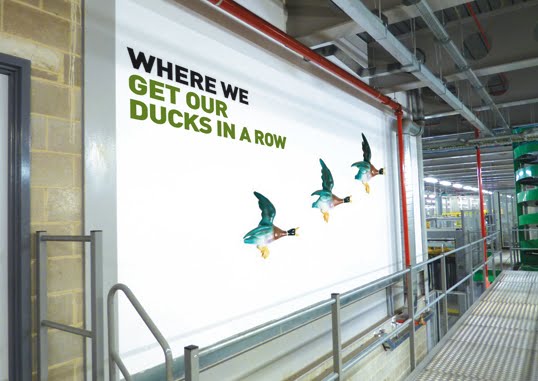
Our latest undertaking is to bring personality to their largest print plant in Broxbourne with the design and installation of interior graphics. Whilst Newsprinters as a business is setting the benchmark in their industry through state-of-the-art technology and a specialised workforce that is second-to-none, the building itself has suffered somewhat from being devoid of any character. Turning that to our advantage, we have literally treated the site as a blank canvas on which we can inject some fun and humour through 50+ wall graphics.
The project has been layered – starting with dividing the site into working zones and introducing colour coding that is translated through colourful walls and a co-ordinated internal wayfinding system. We are now putting the finishing touches to the next layer which applies a theme across the entire building that adds visual interest and provides a stimulating working environment. The concept is simple in its execution yet also thought-provoking for both employees and visitors.
Each graphic is centred around describing a working area or task and is titled 'Where the, Where we, Where it...' and so on... This straightforward, no-nonsense tone of voice is an integral part of their brand and reflects perfectly the people that work in this company, and this industry. Newsprinters' core aim is to simply be 'the best newspaper manufacturer in the world'. No corporate waffle, no long-winded mission statements, just straight to the point. Each 'strapline' is illustrated in a strong, bold and modern font and accompanied by an image of an object that then brings another meaning to that task/area, and in turn, adds a lighthearted element.
The paper reel storage area
The paper reel delivery area
It has been refreshing to work with a client that is open to a creative solution and has the confidence to create a 'non-corporate' environment. Even from the initial brief, Newsprinters made it clear that the scheme should appeal directly to the employees, to provide an uplifting ambience in the surroundings in which they work. Much of the plant is windowless so bringing colour and visual stimulation was imperative. Alongside this, the graphics have to communicate to visitors, many of whom are groups of schoolchildren that take tours of the factory, and so far our humour seems to appeal to those who have seen the ideas.
The press hall
The press control area
We feel that we have fulfilled the potential of the project to the full – through our creative thinking and concept in providing an exciting environment that offers the unexpected but also brings a wry smile to those that see the theme unfold as they go from area to area within the huge plant. We have delivered a vibrant system through the use of various materials, bringing to life the environment in which the staff work, and all within a budget that could well have escalated when considering the sheer scale of the building and the amount of wall space available. We didn't get too carried away and installation takes place next month when the true results and benefits will be seen, and hopefully heard...
I can't lie to you, I'm not the most politically intellectual account manager out there, but I do try and keep abreast of current issues the best I can. During the build up to the general election, the sometimes informative, rarely entertaining and generally repetitive leaders debates were earmarked as a key source of guidance in the build up to 'vote day'. But overall, the most memorable thing I took away from the Sky News coverage on 22nd April was some rather snazzy projection graphics shown on the Bristolian building after the big event was over. This technology is not a new phenomenon, but in my opinion, that didn't detract from the impactful nature of the medium. A series of video animations were shown, taking up the entire building in question, including a mix of logos, images, and culminating in the apparent destruction of the building itself. It certainly caught my attention.
Since then, tothepoint have been in talks with the company behind this often guerilla style marketing approach - Projection Advertising. The best way to get an idea of the potential scale achievable is to check out their site where you can be inspired by previous examples of their work. Our experience in animations lends itself perfectly to a partnership with such an agency - giving the client the opportunity to bring their brand to life on a huge scale.
Additional to the standard projection, there are interactive options including AdWall, AdTrace and AdFloor - a kind of animation which alters when you interrupt it. Clever stuff, which in it's simplicity, manages to really stand head, shoulders and sometimes literally metres above the standard competition of static large scale poster advertising.
Feel free to give us a call on 0207 378 6999 or email us to discuss how your brand could be at the cutting edge of experiential branding.
Increasingly we have been working with many of our clients to help them transfer their print materials into an appropriate digital format. As print becomes more of a unique medium it will still have its place in marketing strategy, helping with standout and differentiation which is still key, but digital can offer so much more if managed and implemented well.
Through research, advice and implementation of our digital strategies we have gained knowledge and experience. We have ensured standout and analytics, plus action based on related activity reports, has helped some of our clients to achieve a significant increase in readership, take-up and awareness of their offering.
As part of this communications change management, digital 'accessibility' is becoming an important growth area for our business and should be for all businesses. We all need to be thinking beyond just ticking the compliance box.
At its most basic, and not going into detailed website compliance, nearly all of our clients see PDFs as a quick and low cost way of converting their print to a digital format that all can access through the web or via email. True, PDFs are probably one of the widest used formats, and reader software is free. They enable people to share information in the way they intended, and the higher end Adobe Acrobat Pro gives some fantastic additional functionality and innovation. But how does this all work when you think of the new regulations and laws being actively enforced to ensure all content is fully accessible for all?
For some time we have been producing interactive PDFs and had moved on to developing these as accessible through basic tags and the Acrobat 'read out loud' feature. There is a plethora of information out there but as Adobe has such a large user base we, like many others, thought that this was all that was required to create a compliant accessible PDF.
However, as we have discovered, this is only the entry level for this area of accessible communication. We believe there are two key issues. The first is content and the second is technology, but I stand ready to be enlightened by any who know more on the second.
From a content perspective, you can structure how a PDF is 'read out loud' or made accessible for those with visual impairment, but does the final document truly convey the messages that someone, who can see the tables and graphs, would have access too? This issue needs to be addressed at content stage. Merely reading out tables or headings and captions of graphics is not enough. The text should be written in such a way that it explains the graphics for this wider audience. After all, the graphics are often there to support and help people speed read a document, often skipping the text. So expanding on the text to help the visually impaired, or even helping those that may not fully understand what you are trying to convey, should not be an issue, but rather a benefit for your audience.
The second issue is the technology. Like I've said, using and perceiving Adobe as the industry standard meant that we didn't test further than the this format. But there are issues with how these PDFs are then converted or used and read on the proprietary software and systems that are used by people with visual impairment to access websites and related content (eg Text Braille, Jaws or Window Eyes). To truly test these PDFs, companies need to either invest in these systems or partner with companies who have them so they can test the accessibility. We have been working with one client, the EPSRC, who have this software, and have discovered anomalies that mean the read order is completely changed when you convert from an Adobe PDF to JAWS. The read out feature jumps around so you could start on the back page and the user would therefore be thoroughly confused. This issue is addressable but requires deeper understanding and training on the software to ensure the PDF is compliant with these different formats.
Our experience has shown that it is better to work on accessibility in the original programmes pre the PDF conversion stage. All of the content should be planned for the wider audience and then made accessible in programmes such as word, powerpoint, indesign or quark.
Without the help of the EPSRC we would have been unaware of these issues and believe many others may still be unaware, clicking a few buttons in acrobat and thinking they have an accessible PDF. This could mean that content currently in the digital arena isn't accessible and at a time when you really want to be seen to be transparent, helpful and accessible, you need to make sure you are fully compliant.
I have added a few extracts and some useful links but there's a lot of reading here so if you'd like some help or advice with the accessibility side of your communications, do get in touch with us. There are many business benefits to having accessible websites and content so it makes sense to ensure you are accessible to all.
Yesterday I saw a comment on Twitter that really threw me. As both a long-time consumer and creator of digital material and also a believer in climate change, this statement really made me stop in my tracks.
Pretty controversial stuff, and shocking if true. For anyone concerned about the environment, this could have major implications. If we want to 'do our bit' should we stop using Google? Presumably 'Bing' and the rest are no more efficient, so does this spell the end of web search completely? Perhaps we just have to abandon the internet altogether in order to save the world?
Or maybe this is just a made up fact designed to get attention? Hmmmm.
Well, a couple of boiling kettles later, I found the origins of this statement. It wasn't made up, it wasn't just a casual tweet created to generate interest and site hits (as if THAT would ever happen!) - turns out this factoid has been going around since the start of the year. And worryingly (well for me anyway) it can be traced back to an article on the Times - so a pretty reputable source of information. You can read it here - and it's replicated in full here for those who are less keen on the new Murdoch Paywall.
A whole bunch of other sites followed up on the story. Here it is on the Telegraph and on the BBC - among many others - and it's obviously still doing the rounds. (Note: by this point I've probably boiled about 6 or 7 kettles and killed a small polar bear).
So, a shocking statement backed up by some serious journalism. But to me, it still doesn't ring true. Is that because I'm too involved with the web and can't let go of my preconceived notions that digital information is actually a GOOD thing for the environment? (saving on paper / waste etc.) Perhaps, perhaps it's worth just one more kettle to find out.
A day after the original article appeared online (and a lot harder to find on Google) this article was published on the Technology News World site, which says:
The Times reporters wrote about a new Harvard study that examines the energy impact of Web searches. One problem: the study's author, Harvard University physicist Alex Wissner-Gross, says he never mentions Google in the study. "For some reason, in their story on the study, the Times had an ax to grind with Google," Wissner-Gross told TechNewsWorld.
And the example involving tea kettles? "They did that. I have no idea where they got those statistics," Wissner-Gross said.
Obviously, Google weren't too happy with these statistics either, here's the view from their side.
Yes, of course computers use energy, but a single search is closer to 0.2 grams of CO2 and that's 35 times less than the Times article suggested. It's interesting to note that the original statement is still circulating around as assumed fact, while the refuting stories have a lot less impact - presumably because they're not associated with a bold, tweetable headline? Which in turn probably says something interesting about the dissemination of news as a whole, ie. the impact of sensationalism vs. more realistic (ie. more boring) information.
What have we learned here? Well, it's always important to check your facts - a growing problem now even within respected news journalism; if they don't do it, then we have to boil a few kettles and do it ourselves. Bias has a tendency to creep in - especially when people are trying to sell us news and there are always (at very least) two sides to every story.
Of course, while the figures reported are widely inaccurate, it does serve to remind us of the fact that using the internet does come with it's own environmental impact - and the more we use and rely on technology - the more PC's/Macs/iPhones etc. we buy - the more energy and CO2 we inevitably consume.
However, ultimately I think the moral of this particular story can be summed up neatly by the article that appeared on Physorg.com here:
"It would appear the London Times was trying to sell newspapers"
Shock news indeed.
Ben Jackson, Head of Digital Media,
www.tothepoint.co.uk