
No Mo
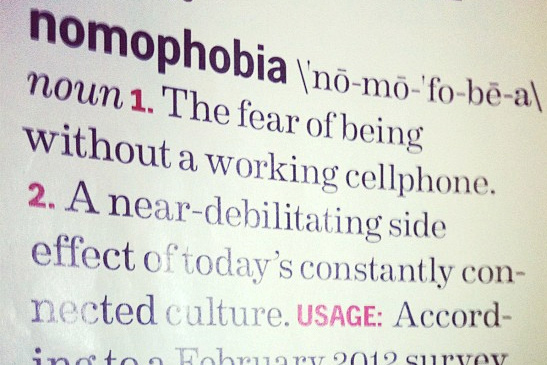
A scary thought maybe - but then it's that scary we need a word for it in the first place. And whilst we may think it slightly ridiculous now - just try a 'digital detox' and see how long you can last without it - perhaps not quite as long as you thought?
more info (the drum)
How to do renovations right.

The National Trust owned stately home Cliveden in Buckinghamshire is currently in the middle of a £3.4 million renovation, with the vast series of works anticipated to last five years.
And, being a caring organisation, The National Trust was worried about the disruption the renovation would cause to visitors, especially as part of the restoration plans involve the property’s historic staircase. So, to counter act the disruption (and inject some fun into the process), the trust has installed a 16.5m slide that lets visitors slide from the roof of the terrace down to the gardens. Now, that's our type of historic sightseeing!
More info (design week)
Jerry's map

Jerry adds to the landscape each day in his coffee break, drawing a card from a specially customized deck to decide what sheet he will work on. And don’t be fooled, this is no half hearted attempt, Jerry has created airports, high courts, cemeteries and train stations. The map is coloured to represent different altitudes, and to bring it to life further, he adds tickets, photographs, magazine cuttings, drawings and other bits and pieces to the existing pages to create textures and layers.
The images and a few brief blog posts really don’t do Jerry’s life-long project justice, so if you’re still curious then watch this brilliant short detailing the Jerry’s whole process.
More info (it's nice that)
 Amazon is slowly taking over the world. And I don't mean Amazon's impressive online shopping service either - I'm referring to Amazon Web Services (AWS) - possibly the largest 'Cloud' service around. Most people don't realise that many of the big web services - from Flipboard to Instagram all run on Amazons servers. In fact it's only when something goes wrong do we realise the implications.
Last week an AWS outage took down Instagram, Vine and several others (including Amazon.com too). Being taken offline is pretty serious for anyone, but for an internet only service it's disastrous. Are these web-based services relying too much on Amazon's Cloud? Perhaps, but it's doubtful that any competitor can ever offer 100% up-time. The answer then is that more companies will have to spread their reliance around as much as possible - otherwise the next outage could leave us all in the lurch! Maybe this Cloud thing is a little less fluffy than we'd imagined?
more info (techcrunch)
 Steve Ballmer, Microsoft's CEO announced his decision to step down - leaving a very different Microsoft from the one he inherited 13 years ago from good ol' Bill. Has his reign been a roaring success? Well if you judge his on-stage performance - he certainly thinks so! (yes, that's real). However, looking back we struggle to see the real vision he's brought to the company - for every success (Windows 7) there's been an equal failure (Windows Vista) - for every innovation (Metro interface design) there's been a cheap knock off copy (Zune).
In fact it's been remarked that Microsoft really doesn't know what to do when its out in-front - it's only when some young upstart (ie. Apple) comes along that the company realises that it has to up its game - but then that's where Microsoft can be dangerous. It does seem to be turning around and realising the up-hill climb its got to face to get back on top (finally, the Microsoft team is starting to think in 'joined-up' terms - desktop, living room, mobile all now sharing a similar approach). Let's hope his replacement just has a little more vision.
more info (the verge)
update: since writing the above it's emerged that not only has Microsoft bought Nokia (for cash no less) but the current Nokia CEO is rumoured as a replacement for the top job at Microsoft... hmmm almost like it was all planned...
 Poor Katie lost her iPhone this month, and being the foolish renagade she is, it wasn’t insured and didn’t feature any of the techie tracking or back up apps on the market now.
We thought she couldn’t be the only ill prepared smartphone owner out there, and clearly Gizmodo feel the same, as this month the technology blog reviewed the best apps to have in your arsenal just in case you ever lose your phone.
Of course just being sensible with your phone is still the best defense, but Katie does like to live on the edge.
Gathering Clouds
Last week an AWS outage took down Instagram, Vine and several others (including Amazon.com too). Being taken offline is pretty serious for anyone, but for an internet only service it's disastrous. Are these web-based services relying too much on Amazon's Cloud? Perhaps, but it's doubtful that any competitor can ever offer 100% up-time. The answer then is that more companies will have to spread their reliance around as much as possible - otherwise the next outage could leave us all in the lurch! Maybe this Cloud thing is a little less fluffy than we'd imagined?
more info (techcrunch)
Shut the Gates on your way out
In fact it's been remarked that Microsoft really doesn't know what to do when its out in-front - it's only when some young upstart (ie. Apple) comes along that the company realises that it has to up its game - but then that's where Microsoft can be dangerous. It does seem to be turning around and realising the up-hill climb its got to face to get back on top (finally, the Microsoft team is starting to think in 'joined-up' terms - desktop, living room, mobile all now sharing a similar approach). Let's hope his replacement just has a little more vision.
more info (the verge)
update: since writing the above it's emerged that not only has Microsoft bought Nokia (for cash no less) but the current Nokia CEO is rumoured as a replacement for the top job at Microsoft... hmmm almost like it was all planned...
At a loss

We thought she couldn’t be the only ill prepared smartphone owner out there, and clearly Gizmodo feel the same, as this month the technology blog reviewed the best apps to have in your arsenal just in case you ever lose your phone.
Of course just being sensible with your phone is still the best defense, but Katie does like to live on the edge.
Timelapse Photography re-imagined

Fong Qi Wei's timelapse photographs are a beautiful, yet frankenstein-esque, look through time and capture the stunning effect that sunrise or sunset can have on a land or city scape. The only thing to do with these images is simply enjoy them.


